Investing where Housing is Scarce: Club Deals give Investors Access to Real Estate Developments
![[Translate to Englisch:]](/assets/group/_processed_/4/9/csm_AdobeStock_341776315_5e54088fc2.jpeg "[Translate to Englisch:]")
Switzerland’s housing shortage is driving up prices for residential property and rents for apartments. At the same time, too little is being built in Switzerland — often due to a lack of know-how and resources.
Swiss Finance & Property Group (SFP Group), together with EROP Real Estate & Partners, provides investors with direct access to real estate developments through EROP Club Deals. Qualified investors benefit from an institutionalized approach to selected development projects and the expertise of a developer with a proven track record. The focus is on developing investment properties as well as owner-occupied residential units. The objective: to generate an attractive return on invested capital of at least 15% p.a. for investors.
Swiss Housing Market: Structural Imbalances and Persistent Scarcity
The Swiss housing market is extremely tight. The vacancy rate stood at just 1% at the end of June last year — a clear indication of a nationwide shortage of available housing. In urban centers, the trend is even more pronounced: in the canton of Zurich, the rate was only 0.5% (Source: Federal Statistical Office).
Transaction prices for residential property as well as rental prices have also continued to rise. The persistent supply shortage has driven prices up significantly over many years. The temporary interest rate effect in 2022/2023 merely slowed this dynamic slightly (Source: Wüest Partner).
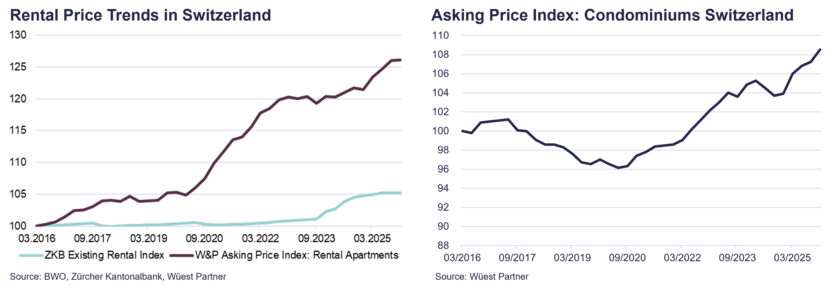
A closer look at net immigration and the growth of the permanent resident population shows that residential construction has broadly kept pace with population growth. In addition to immigration, the record-low vacancy rates are being driven by the trend toward smaller apartments and declining average household sizes.
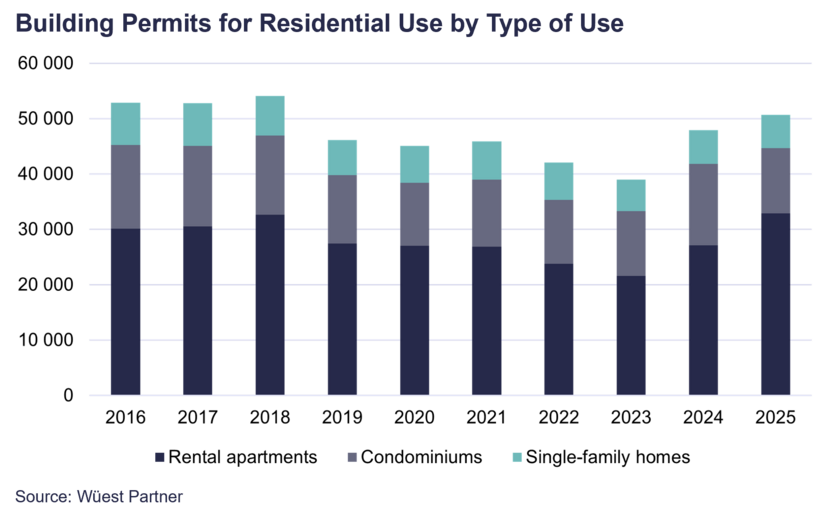
Although Wüest Partner forecasts a renewed increase in investment in residential properties in 2025, volumes are expected to remain well below the level required for a sustainable easing of the housing shortage.
Building in Switzerland: Opportunities and challenges
In principle, the current supply-demand imbalance should make development highly attractive. Nevertheless, construction activity has not increased significantly in recent years (Source: Federal Statistical Office). This is reflected not only in stagnating direct construction investment but also in the flat number of building applications.
The challenges are less related to financing and more to operational execution. Four key resource-intensive factors are slowing down the building process and shaping the success of development projects:
- Complex approval procedures:
The average approval period for multi-family buildings has increased significantly in recent years. According to UBS, it currently ranges between 200 and 230 days, and considerably longer in major cities — around 305 days in Zurich and approximately 210 days in Lausanne. The main reasons are increasing regulatory density, more complex requirements, and a growing number of objections. - Greater structural and technical complexity:
Higher standards for living quality, energy efficiency, and sustainability are leading to more demanding construction processes and increasingly sophisticated building technology. At the same time, modern systems create added value, such as digital access solutions and intelligent heating and ventilation controls. Close coordination among all project participants is essential to ensure cost and planning certainty. - Shortage of skilled labor in the construction industry:
Qualified professionals are scarce and often booked out long term. This makes tendering processes more complex and increases the importance of coordination and oversight of trades. The shortage also raises the risk of delays and quality issues. - Disciplined acquisition with a clear vision and consistent margin focus:
Project success begins with the right acquisition. Real estate developments involve additional risks, including planning uncertainties, construction cost developments, and market demand. A precise assessment of costs, market potential, project planning, and execution at an early stage is crucial to securing attractive margins for investors.
EROP & SFP Group: Key success factors for efficient real estate developments
A successful development process is based on multidisciplinary collaboration. Through EROP Club Deals, SFP provides investors with exactly this approach.
EROP’s team has many years of experience in real estate development and an excellent track record. The development process includes:
- Comprehensive planning and engineering services at a fixed price
- Tendering and objection management, with a proactive dialogue approach
- Project supervision through to full completion
- Consistent budget control through optimized planning and design processes
This approach enables the identification of cost potential, the minimization of risks, and the efficient execution of projects.
The SFP Group assumes the role of asset manager:
- Review and selection of club deals prior to launch
- Sourcing of suitable properties
- Transparent disclosure of all cost and return expectations
- Support of each project from launch to liquidation
- Monitoring of key milestones
- Ongoing communication with investors
This ensures that each investment is professionally assessed, consistently monitored, and managed with full transparency.
Contact

Corporate Finance Manager

Head Corporate Finance & Capital Markets